
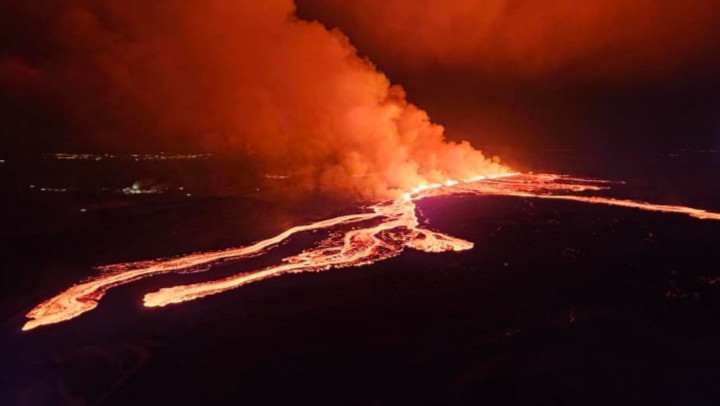
In 2024, Iceland recorded several volcanic eruptions that formed new lava flows and active eruption zones, mainly in the southwestern part of the country on the Reykjanes Peninsula. These events are part of an ongoing volcanic awakening that began in 2021 after a long period of relative calm.
Main eruption locations
Most of the volcanic activity took place near the town of Grindavík and along fissure systems in the Reykjanes Peninsula. This region has become the most active volcanic area in recent years.
Key affected areas included:
- Surroundings of Grindavík
- The Sundhnúkur crater row
- Zones between Hagafell and Stóra-Skógfell
- Fissure systems linked to the Svartsengi volcanic area
Instead of a single volcano, the eruptions occurred through long cracks in the ground, releasing lava along extended fissures.
Timeline of 2024 eruptions
Volcanic activity occurred in several phases throughout the year:
- Early 2024: Lava fissures opened close to Grindavík, impacting nearby infrastructure
- March 2024: Another eruption formed between Hagafell and Stóra-Skógfell, producing fresh lava flows
- May 2024: A stronger eruption sent lava fountains into the air and expanded existing lava fields
- Additional smaller eruptions continued within the same volcanic system later in the year
Formation of new lava landscapes
The repeated eruptions significantly reshaped the landscape of the Reykjanes Peninsula. New geological features include:
- Fresh lava fields spreading near Grindavík
- Thick layers of hardened lava covering older terrain
- Newly formed fissure zones where the ground continues to split
In some cases, lava flows approached protective barriers built to safeguard roads and geothermal facilities.
Why eruptions keep occurring here
The Reykjanes Peninsula lies on the Mid-Atlantic Ridge, where tectonic plates are slowly moving apart. This geological setting allows magma to rise easily to the surface, leading to frequent fissure eruptions.
After centuries of inactivity, volcanic activity resumed in 2021 and has continued repeatedly in the same system.
Effects of the eruptions
The 2024 eruptions caused:
- Temporary evacuation of residents in Grindavík
- Damage to infrastructure such as roads and buildings
- Disruptions to nearby tourist attractions
- Continuous monitoring by Icelandic emergency agencies
Although disruptive, most eruptions were localized and managed through early warning systems and protective measures.
Conclusion
The volcanic events of 2024 in Iceland were concentrated mainly on the Reykjanes Peninsula, where multiple fissure eruptions created new lava fields and reshaped the terrain. Rather than forming a new volcano, the activity appeared across several connected eruption zones.
These developments show that southwestern Iceland has entered an active volcanic period that may continue into the future.

