
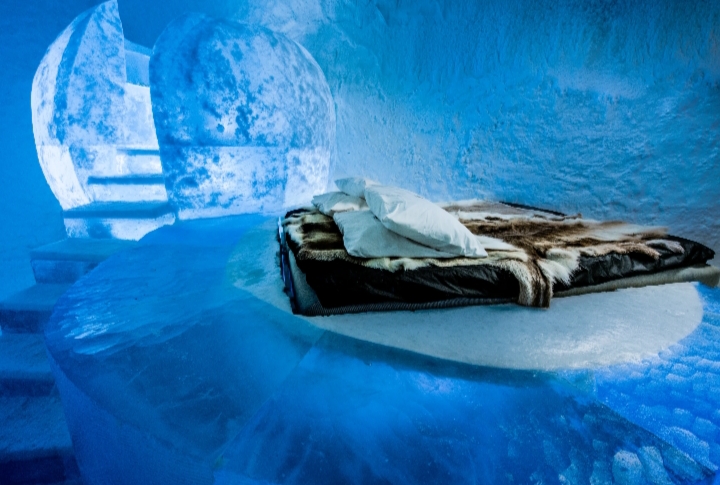
In the far north of Sweden, where winter dominates most of the year and the Torne River freezes into thick, glassy ice, stands one of the most unusual hotels in the world. The ICEHOTEL in the village of Jukkasjärvi is rebuilt every year from ice and snow, only to melt away completely when spring arrives. What makes it remarkable is not just its frozen structure, but the fact that it is constantly recreated in new forms, never looking the same twice.
A creative idea born from ice and chance
The ICEHOTEL began in 1989 as a small experimental art project. Ice taken from the Torne River was used to build an exhibition space for ice sculptures. When visitors could not find nearby accommodation, some were allowed to sleep inside the structure. That spontaneous decision led to the idea of creating a hotel made entirely from ice—a concept that has since become world-famous.
Over time, the project evolved into a fully functional seasonal hotel that is rebuilt each winter and disappears in spring, turning it into a living, changing artwork rather than a permanent building.
Why it is rebuilt every year
The hotel’s temporary nature is due to its materials. It is made mostly from natural ice and compacted snow, which cannot survive warm temperatures. As a result, construction starts each winter when the Torne River freezes solid.
Each year, thousands of tons of ice are harvested and stored in cold facilities powered partly by renewable energy. These blocks of ice are later carved into rooms, furniture, sculptures, and decorative features. When temperatures rise in spring, the entire structure gradually melts and flows back into the river.
This cycle of construction and disappearance is central to the hotel’s identity.
Art, design, and imagination in frozen form
One of the most distinctive features of the ICEHOTEL is that it is redesigned every year by international artists and architects. Through an open selection process, creators submit ideas for themed rooms, and chosen participants travel to Sweden to build them on-site using ice as their medium.
The result is a collection of individually designed suites that function like temporary art installations. Some rooms resemble frozen forests or icy caves, while others play with light, color, and abstract shapes to create surreal environments.
Even practical items such as beds and chairs are carved from ice, combined with insulating materials like reindeer skins and thermal padding to keep guests warm.
What it is like to stay there
Staying at the ICEHOTEL is a very different experience from a typical hotel stay. Inside the ice rooms, temperatures remain below freezing, usually around -5°C (23°F). Guests sleep in specially designed thermal sleeping bags after preparing in warmer areas of the hotel.
Most visitors stay only one night in the ice rooms before moving to heated accommodations nearby. However, the experience is less about comfort and more about immersion—sleeping inside a work of art that exists only for a short time.
Outside, the Arctic environment adds to the atmosphere, with long winter nights, quiet snow-covered landscapes, and the possibility of seeing the northern lights.
More than rooms: ice bars, chapels, and exhibitions
The ICEHOTEL also includes other frozen spaces, such as an ice bar where even the drinking glasses are made of ice, and an ice chapel used for weddings and ceremonies. These spaces are designed with the same artistic approach as the guest rooms.
Throughout the season, visitors can explore large-scale ice sculptures and installations that function like a temporary museum made entirely of frozen water.
Sustainability and modern innovation
Despite its fragile appearance, the ICEHOTEL incorporates sustainable practices. It uses natural river ice, and the meltwater is returned to the Torne River, keeping the environmental impact low. Cold storage facilities help preserve ice using energy-efficient systems, including renewable energy sources.
A newer addition, ICEHOTEL 365, allows selected ice suites to remain open year-round using solar-powered cooling technology. This makes it possible to experience ice art even outside the winter season while reducing environmental impact.
A global attraction shaped by impermanence
Today, the ICEHOTEL is one of Sweden’s most famous tourist destinations, attracting visitors from around the world. It also serves as a platform for international artists to experiment with ice as a creative medium, blending architecture, sculpture, and environmental design.
More than just a hotel, it represents a shift in how we think about buildings—not as permanent structures, but as experiences that can exist temporarily and then transform.
Conclusion
The ICEHOTEL in Jukkasjärvi is unique because it embraces change instead of resisting it. Built from ice, redesigned every year, and destined to melt away, it challenges the idea that architecture must last forever.
Its beauty lies in its impermanence: a place where guests sleep inside art that will soon disappear, leaving only memory behind.

