
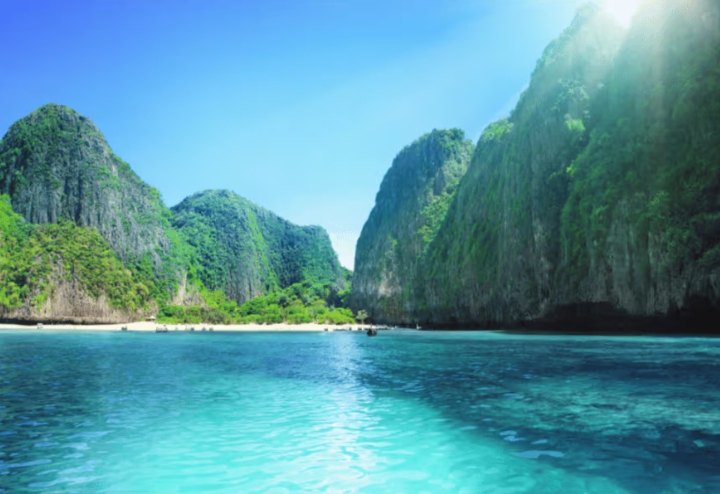
Maya Bay, one of Thailand’s most famous natural attractions, has reopened to visitors after years of closure, but access is now heavily regulated to protect its recovering ecosystem. Situated on Ko Phi Phi Leh in the Andaman Sea, the bay gained global attention after featuring in the movie The Beach, which also contributed to its environmental decline due to overwhelming tourism.
Following significant ecological damage, the Thai government closed the site in 2018 to allow nature to recover. After several years of restoration, Maya Bay was reopened in 2022 with strict management measures that continue today.
Reasons for the Closure
Before its shutdown, Maya Bay experienced extreme tourist pressure. Thousands of daily visitors led to serious environmental issues such as:
- Destruction of coral reefs from boats and human activity
- Decline in marine biodiversity
- Coastal erosion caused by constant foot traffic
- Water pollution from waste and chemical products
The damage became so severe that authorities were forced to suspend tourism to allow natural restoration.
Controlled Reopening and New Guidelines
When Maya Bay reopened, it was transformed into a regulated eco tourism zone within Hat Noppharat Thara–Mu Ko Phi Phi National Park. The focus shifted from mass tourism to environmental protection.
New management measures include:
- Limited number of visitors allowed each day
- Time restrictions on how long tourists can stay
- No direct boat landing on the beach
- Access only through designated walkways
- Seasonal closures to support ecosystem recovery
These steps aim to ensure the bay is not overexploited again.
Visitor Restrictions and Environmental Protection
To safeguard the fragile environment, strict rules are now enforced:
- Swimming in the bay is prohibited to protect coral and marine life
- Boats must dock at designated points away from the beach
- Visitors must walk through controlled access paths
- Certain sunscreens and pollutants are restricted
- Violations can result in fines
These regulations are part of Thailand’s broader effort to restore marine ecosystems.
Signs of Environmental Recovery
Since the introduction of these protections, Maya Bay has shown encouraging improvements:
- Coral reefs are gradually regenerating
- Marine species such as reef sharks are returning
- Water quality has improved noticeably
- Overall biodiversity is slowly increasing
The site is now often highlighted as a success story in environmental rehabilitation.
A Shift Toward Sustainable Tourism
Maya Bay’s new management approach reflects a broader change in tourism philosophy. Instead of focusing on large visitor numbers, authorities now prioritize:
- Long-term conservation of natural habitats
- Controlled and limited tourism flow
- Environmental education for visitors
- Sustainable benefits for nearby communities
Conclusion
Today, Maya Bay operates not as an unrestricted beach destination, but as a carefully protected marine environment. Its reopening demonstrates that tourism and conservation can coexist provided strict rules are respected and enforced.

